-
 Email: kemaisi17710570236@gmail.com
-
 Tel: +86 18031173072
 Email: kemaisi17710570236@gmail.com
Tel: +86 18031173072
When sourcing a frozen meat cutter Supplier, industrial processors often struggle to balance cutting precision with the physical resistance of sub-zero proteins. The challenge lies in achieving clean, uniform slices without thawing the product, which would compromise food safety and texture. For high-volume operations in the meat processing industry, the efficiency of the cutting stage dictates the entire production timeline, making the choice of equipment a critical operational decision.
Reliable cutting technology is not an isolated requirement but a core component of a broader meat processing line. Whether integrated with a Frozen & Fresh Meat Grinder or preceded by a Meat Elevator, the ability to handle frozen blocks with consistency reduces material waste and labor costs. The synergy between a high-performance cutter and subsequent processing steps ensures that the final product maintains the structural integrity required for retail or wholesale packaging.
Evaluating a supplier requires looking beyond basic specifications to understand how the machinery handles specific meat densities and temperature variances. This analysis examines the technical prerequisites for efficient frozen meat portioning and how to identify a partner capable of delivering industrial-grade reliability. For those seeking a professional frozen meat cutter Supplier, understanding the intersection of blade metallurgy and motor torque is the first step toward optimizing yield.


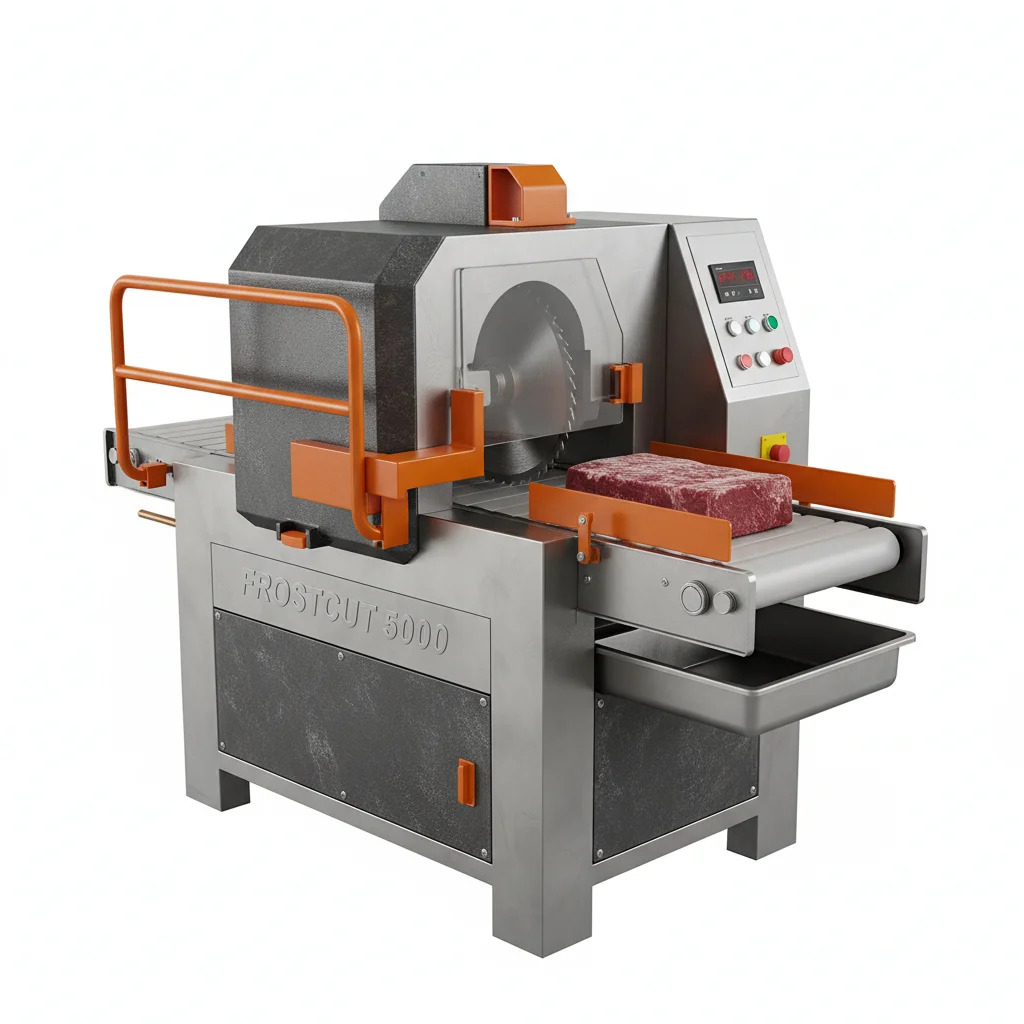
Industrial frozen meat cutters operate on the principle of high-torque mechanical force combined with specialized blade geometries. Unlike fresh meat slicing, frozen cutting requires the equipment to overcome the crystalline structure of frozen water and fat, which acts as a hard composite material. The machinery must provide sufficient downward pressure and rotational speed to shear through the product without causing "shattering" or uneven edges.
From a structural standpoint, these machines integrate heavy-duty frames to minimize vibration, which is essential for maintaining slice thickness accuracy. The interaction between the feed system and the cutting head determines the throughput capacity. By precisely controlling the advance rate, the system ensures that each cut is clean, reducing the amount of "meat dust" or fines that typically result in product loss in lower-quality equipment.
The durability of a frozen meat cutter is primarily dictated by the grade of stainless steel used in the contact parts and the resilience of the drive system. Food-grade, corrosion-resistant materials are mandatory not only for hygiene but to prevent the pitting that occurs during the rigorous chemical cleaning processes required in meat plants. When the frame lacks sufficient rigidity, the resulting oscillation leads to premature blade wear and inconsistent product dimensions.
The most critical factor for long-term ROI is the alignment between motor torque and blade sharpness; under-powered motors force the operator to rely on excessive blade speed, which accelerates heat buildup and degrades the tempering of the steel, leading to frequent failures.
Additionally, the sealing system around the rotating shafts must be robust enough to prevent frozen particles and moisture from entering the gearbox. In environments where temperatures fluctuate, the use of specialized lubricants that maintain viscosity in cold conditions is essential. A supplier's ability to provide modular components for quick replacement directly impacts the total uptime of the processing line.
When comparing different cutting technologies, processors focus on the relationship between cutting speed and product yield. Higher precision in thickness control allows for a higher percentage of "A-grade" cuts per block of meat. For instance, a deviation of just 2mm in slice thickness across a thousand units can lead to significant revenue loss due to overweight portions or unsellable undersized pieces.
Efficiency is further measured by the energy consumption per kilogram of processed meat. Advanced systems utilize variable frequency drives to optimize power usage based on the density of the meat being processed, ensuring that the machine does not draw maximum current during lighter cuts, thereby extending the lifespan of the electrical components.
Frozen meat cutters are indispensable in the production of pre-portioned retail packs and industrial ingredients. In large-scale sausage manufacturing, for example, frozen meat blocks are often sliced into manageable sizes before being fed into a Meat Grinder or a Vacuum Quantitative Filling Machine. This sequential process ensures that the grinding stage is not overwhelmed by oversized frozen masses, protecting the grinder's screw and plates.
Beyond bulk processing, these machines are used in the specialized production of frozen steaks, patties, and dicing for ready-meal components. In these scenarios, the focus shifts from raw throughput to geometric accuracy. The ability to integrate the cutter with a conveyor system allows for a continuous flow, reducing the manual handling of heavy frozen blocks and enhancing workplace safety.
The industry is shifting toward fully automated, sensor-driven cutting systems. Traditional manual-feed cutters are being replaced by systems that use optical sensors to detect the exact dimensions of the meat block before the cut is initiated. This eliminates human error and ensures that the maximum possible value is extracted from every piece of raw material.
Another significant trend is the integration of PLC (Programmable Logic Controller) systems that allow operators to save specific cutting profiles for different products. This versatility means a single machine can switch from dicing for a stew mix to slicing for thin-cut fillets in a matter of minutes, greatly increasing the operational flexibility of the plant.
Furthermore, the development of cryogenic-resistant alloys for blades has reduced the frequency of sharpening intervals. By maintaining a sharper edge for longer periods, these machines reduce the heat generated during friction, which prevents the superficial melting of the meat surface and preserves the product's visual appeal.
Integrating a frozen meat cutter into an existing line often reveals bottlenecks in material handling. If the Meat Elevator cannot keep up with the cutter's speed, the machine spends too much time idling, which wastes labor and energy. The solution lies in implementing a buffered conveyor system that ensures a steady supply of blocks to the cutting head.
Another challenge is the management of waste and scraps. High-efficiency plants implement a dedicated recovery system where the trimmings from the cutter are immediately diverted to a Frozen & Fresh Meat Grinder for use in lower-grade products like minced meat or sausages, ensuring zero-waste production.
Finally, hygiene maintenance in the cutting area can be difficult due to the accumulation of frozen protein residues. Implementing a modular design where the cutting head can be detached and sanitized separately reduces downtime and ensures compliance with strict international food safety standards.
| Criteria | Low-Capacity | Mid-Range | Industrial High-Volume |
|---|---|---|---|
| Material Grade | Standard SS | Hardened SS | Premium Alloy SS |
| Control System | Manual | Semi-Auto | Full PLC Control |
| Blade Life | Short | Moderate | Extended (Tungsten) |
| Integration | Standalone | Conveyor Link | Fully Automated Line |
| Waste Rate | Moderate | Low | Minimal |
| Maintenance | High Manual | Scheduled | Predictive/Modular |
The primary difference is the torque and blade composition. Frozen meat cutters are designed to shear through crystalline ice structures in proteins, requiring significantly higher motor torque and blades made from hardened alloys that can withstand high resistance without dulling or chipping. Fresh meat slicers focus on speed and thinness for soft tissues, whereas frozen cutters prioritize force and structural stability.
Capacity should be determined by calculating your peak hourly throughput requirements and adding a 20% buffer for maintenance and loading pauses. You must also ensure the cutter's output matches the input capacity of your subsequent machines, such as your Meat Grinder or Vacuum Filling Machine, to prevent bottlenecks in the workflow.
Yes, most industrial cutters can handle beef, pork, and poultry, but the required settings differ. Denser proteins like frozen beef require slower feed rates and higher torque to ensure a clean cut. Suppliers typically provide adjustable speed controls to allow operators to optimize the process based on the specific density and temperature of the meat block.
Blade lifespan depends on the volume of meat processed and the presence of contaminants (like bone fragments). In high-volume industrial settings, blades are typically sharpened every 40-100 operating hours. Using premium tungsten-carbide tipped blades can extend this interval significantly, reducing downtime and maintaining consistent slice quality.
Absolutely. Modern cutters are designed with PLC interfaces that allow them to communicate with conveyors, elevators, and weighing scales. By synchronizing the cutter with a Meat Elevator and a downstream packaging system, plants can achieve a "hands-free" process that maximizes hygiene and throughput.
Uneven cuts are usually caused by three factors: dull blades, excessive feed speed, or lack of frame rigidity. If the blade is dull, it "pushes" the meat rather than shearing it; if the feed is too fast, the meat may deform; and if the frame vibrates, the slice thickness will vary. Regular calibration and maintenance are the only ways to prevent these issues.
Selecting the right frozen meat cutter is a strategic decision that impacts every stage of the cold-chain production process. By focusing on the critical balance of motor torque, blade metallurgy, and frame stability, processors can significantly reduce product waste and increase their overall yield. The transition from manual cutting to automated, PLC-driven systems represents the most effective path toward operational scalability and consistent product quality in the modern meat industry.
For enterprises looking to modernize their production lines with reliable, industrial-grade equipment, partnering with a supplier who understands the nuances of meat density and cold-chain logistics is essential. To explore advanced solutions for meat processing and portioning, you are invited to visit the technical resources available at www.hamkms.com for detailed specifications and integration guidance.

If you are interested in our products, you can choose to leave your information here, and we will be in touch with you shortly.